10 Best Writing Tools for Authors to Create a Cozy, Productive Workspace in 2026
Because the right writing setup won’t write the book for you — but it can make it much easier to keep showing up.
Miriam Ali
7/9/202614 min read
Introduction
Writing a book is one of the most rewarding creative journeys you’ll ever take, but let’s be honest: it isn’t always easy.
Some days, the words arrive like they’ve been waiting politely by the door. Other days, you’re fighting distractions, stiff shoulders, a cold cup of coffee, an uncomfortable desk setup, or the tiny panic of wondering whether your manuscript is actually backed up somewhere safe.
Over the years, I’ve learned that writing well isn’t just about talent or inspiration. It’s also about creating an environment that helps you return to the page again and again.
The right tools won’t write your novel, outline your chapters, or magically fix a stubborn plot hole. If only. But they can make your writing time feel more comfortable, focused, organised, and enjoyable.
Below, I’ve gathered ten writing tools that can help authors build a calmer, more productive workspace — whether you’re drafting your first novel, self-publishing your next book, blogging from home, or simply trying to make your writing routine feel a little more inviting.
Disclosure
Disclosure: This post contains affiliate links. As an Amazon Associate, I earn from qualifying purchases. If you purchase through my links, I may earn a small commission at no extra cost to you. I only recommend products I genuinely believe can be helpful for writers, readers, and creative professionals.
Quick Picks: Best Writing Tools for Authors
Here’s a quick look at the top recommendations if you’re short on time or comparing options before reading the full reviews.
Need Best Pick Why It Stands Out
Best overall writing tool Logitech MX Keys S Comfortable, quiet, and ideal for long typing sessions
Best for posture Nulaxy Ergonomic Laptop Stand Raises your screen for a healthier desk setup
Best for editing Logitech MX Master 3S Smooth, precise, and comfortable for long document work
Best for focus Sony WH-1000XM5 Excellent noise cancellation for distraction-free writing
Best for reading and notes Kindle Scribe Great for reading, annotating, and reviewing drafts
Best for evening writing Lepro LED Desk Lamp Adjustable lighting for a softer workspace
Cosiest writing upgrade COSORI Mug Warmer Keeps coffee or tea warm during writing sessions
Best analog tool LEUCHTTURM1917 Hardcover Notebook Beautiful, durable notebook for ideas and planning
Best for writing goals Clever Fox Planner Helps track deadlines, habits, and writing progress
Best for manuscript
Backups Samsung T7 Portable SSD Fast, portable storage for protecting your work
These ten products create a balanced writing setup: comfort, focus, planning, cosy atmosphere, and file protection.
1. Logitech MX Keys S Wireless Keyboard
🌿 Muphoria Recommends
Best For: Writers who spend hours typing every day
Rating: ⭐⭐⭐⭐⭐
A keyboard is one of those tools you don’t think about much until you use one that makes typing feel easier. If you spend hours drafting chapters, editing blog posts, responding to emails, or outlining your next book, a comfortable keyboard can make a noticeable difference.
The Logitech MX Keys S is a strong choice for writers because it feels quiet, smooth, and steady without being overly flashy. The keys are low-profile and responsive, which makes it easier to settle into a rhythm during long writing sessions. It also has smart backlighting that adjusts to your environment, which is especially helpful if you write early in the morning or late at night.
This keyboard also connects to multiple devices, so you can move between a laptop, desktop, or tablet without constantly changing your setup. For writers who work across several devices, that small convenience can save a surprising amount of friction.
Why I Recommend It
The Logitech MX Keys S feels like a practical upgrade for writers who want their desk setup to feel more comfortable and professional. It’s not the cheapest keyboard available, but it earns its place because of the typing experience, quiet keys, and premium build.
Pros
Comfortable for long writing sessions
Quiet, satisfying keys
Rechargeable battery
Smart backlighting
Connects to multiple devices
Clean, minimal design
Considerations
More expensive than basic keyboards
Writers who love loud mechanical keyboards may prefer a different feel
2. Nulaxy Ergonomic Laptop Stand
Best For: Writers who want better posture
Rating: ⭐⭐⭐⭐⭐
If you write on a laptop, it’s easy to spend hours hunched over the screen without realising what your neck and shoulders are quietly enduring. A laptop stand is a simple upgrade, but it can completely change the comfort of your workspace.
The Nulaxy Ergonomic Laptop Stand lifts your laptop closer to eye level, which encourages better posture and helps reduce the strain that comes from looking down all day. It also creates a cleaner desk setup, especially when paired with an external keyboard and mouse.
For authors who write at home, in a small office, or even at the kitchen table, this stand is a practical way to make a laptop feel more like a proper workstation.
Why I Recommend It
This is one of those tools that doesn’t feel glamorous, but it matters. Good posture may not sound as romantic as candlelight and fresh notebooks, but your future shoulders will be deeply grateful.
Pros
Raises your laptop to a more comfortable height
Helps reduce neck and shoulder strain
Sturdy design
Simple, minimal look
Frees up desk space underneath the laptop
Works well with an external keyboard and mouse
Considerations
You’ll get the most benefit if you also use a separate keyboard and mouse
Not ideal if you need a stand that folds completely flat for travel
3. Logitech MX Master 3S Wireless Mouse
Best For: Editing manuscripts, research, and long document work
Rating: ⭐⭐⭐⭐⭐
Writing is not only typing. A lot of the work happens during editing, formatting, researching, scrolling through long documents, moving between tabs, and rearranging sections that once seemed perfectly fine but now need emotional support.
The Logitech MX Master 3S is a favourite productivity mouse for a reason. It has a comfortable shape, precise tracking, quiet clicks, and a scroll wheel that makes moving through long manuscripts much smoother.
If you edit your own work, write blog posts, manage research notes, or spend time in tools like Google Docs, Microsoft Word, Scrivener, Canva, or WordPress, a quality mouse can make the process feel less clunky.
Why I Recommend It
This mouse is especially helpful for writers who do more than draft. If your writing life includes editing, publishing, designing, outlining, or managing online content, the MX Master 3S can make those tasks feel easier and more efficient.
Pros
Comfortable ergonomic shape
Quiet clicks
Excellent scroll wheel
Great for long documents
Useful for editing and research
Connects to multiple devices
Considerations
Higher price than a basic wireless mouse
May feel large for writers with smaller hands
4. Sony WH-1000XM5 Noise-Canceling Headphones
Best For: Writers who need quiet and focus
Rating: ⭐⭐⭐⭐⭐
Every writer needs a little peace and quiet — or at least the illusion of it.
The Sony WH-1000XM5 headphones are a beautiful option for writers who struggle with background noise, busy households, coffee shop chatter, or general distractions. Their noise cancellation can help create a focused writing bubble, even when your surroundings are less than peaceful.
They’re also comfortable enough for longer sessions, which matters if you like listening to instrumental music, ambient sounds, or white noise while drafting.
Why I Recommend It
Focus is one of the most valuable things a writer can protect. These headphones are definitely an investment, but for writers who are easily distracted or often work in noisy environments, they can make writing time feel more private and intentional.
Pros
Excellent noise cancellation
Comfortable for long sessions
Strong sound quality
Helpful for writing in shared spaces
Great for music, audiobooks, and focus playlists
Lightweight, modern design
Considerations
Premium price point
Maybe more than casual users need
5. Kindle Scribe
Best For: Reading, annotating, and draft review
Rating: ⭐⭐⭐⭐⭐
Reading is one of the best ways to become a better writer. The more you read, the more you start to notice pacing, structure, dialogue, chapter endings, and all those subtle craft choices that make a book work.
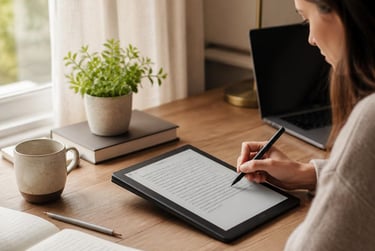
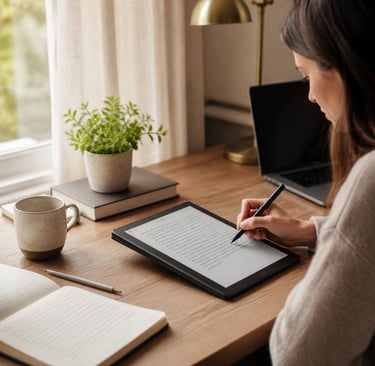
The Kindle Scribe is especially useful because it combines reading with note-taking. You can highlight passages, jot down thoughts, mark ideas, and use it as a digital notebook. For authors, that can be helpful not only for reading books in your genre, but also for reviewing drafts, collecting ideas, and studying story structure.
It’s not a necessary tool for every writer, but if you love reading and want a more organised way to capture notes, it’s a lovely addition to your writing life.
Why I Recommend It
The Kindle Scribe is especially helpful for writers who are also serious readers. It keeps your reading, notes, and ideas in one lightweight device, which can make creative study feel more intentional.
Pros
Great for reading and annotation
Useful for taking notes
Large screen compared to standard Kindles
Long battery life
Helpful for studying books in your genre
Reduces the need for multiple notebooks
Considerations
More expensive than a standard Kindle
Best for writers who will actually use the note-taking features
6. Lepro LED Desk Lamp
Best For: Evening writing and cosy workspace lighting
Rating: ⭐⭐⭐⭐☆
Good lighting makes a bigger difference than many writers realise. A harsh overhead light can make your workspace feel cold, while dim lighting can strain your eyes and make late-night writing sessions harder than they need to be.
The Lepro LED Desk Lamp is a practical choice for writers who want adjustable lighting without taking up too much space. Depending on the model, many Lepro lamps offer different brightness levels and colour temperatures, which makes it easier to shift from focused work to a softer evening atmosphere.
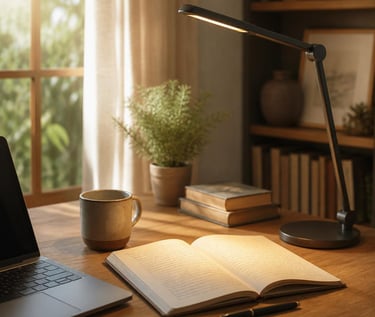
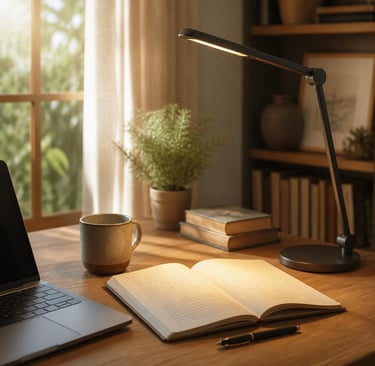
For Muphoria’s cosy writing style, lighting matters. A warm desk lamp can make your writing space feel inviting — the kind of place you actually want to return to.
Why I Recommend It
This is a simple upgrade that supports both function and atmosphere. It helps your desk feel calmer, warmer, and more comfortable during early morning or evening writing sessions.
Pros
Adjustable brightness
Helpful for reducing eye strain
Works well for evening writing
Compact desk-friendly design
Creates a softer writing environment
Budget-friendly compared to many office upgrades
Considerations
Features vary by model
May not be decorative enough if you want a statement lamp
7. COSORI Mug Warmer
Cosiest Pick
Best For: Coffee and tea lovers
Rating: ⭐⭐⭐⭐☆
We’ve all been there.
You sit down with a fresh cup of coffee or tea, open your manuscript, find your rhythm, write a few surprisingly decent paragraphs… and then reach for your mug only to discover it has become tragically lukewarm.
The COSORI Mug Warmer is a small but delightful desk upgrade for writers who like having a warm drink nearby. It keeps your coffee, tea, or cocoa warm while you work, which makes long writing sessions feel a little more comforting.
Is it essential? Not exactly. Is it the kind of cosy little tool that makes your desk feel more inviting? Absolutely.
Why I Recommend It
This is one of those products that fits the emotional side of writing. Sometimes, a warm drink beside your keyboard is part of the ritual that helps you settle in and begin.
Pros
Keeps drinks warm during writing sessions
Great for coffee, tea, or cocoa
Cosy and giftable
Easy to keep on a desk
Makes writing sessions feel more inviting
Considerations
Works best with compatible flat-bottom mugs
Not as essential as comfort or backup tools
8. LEUCHTTURM1917 Hardcover Notebook
Best For: Capturing ideas, outlining, and journaling
Rating: ⭐⭐⭐⭐⭐
Even in a digital world, there’s something special about a good notebook.
The LEUCHTTURM1917 Hardcover Notebook is a favourite among writers, journalers, planners, and creative thinkers because it feels sturdy, elegant, and practical. It’s useful for capturing story ideas, brainstorming character details, outlining chapters, tracking book research, or keeping a simple writing journal.
Some ideas arrive when your laptop is closed. Others show up in the middle of a walk, during a conversation, or right before you fall asleep. Having a dedicated notebook gives those ideas somewhere safe to land.
Why I Recommend It
A notebook gives your writing life a physical home. It’s perfect for messy thinking, early ideas, and creative notes that don’t need to be polished yet.
Pros
High-quality hardcover design
Great for brainstorming and planning
Useful for journaling
Portable enough to keep nearby
Available in different colours and page styles
Feels beautiful and intentional
Considerations
More expensive than basic notebooks
Writers who prefer fully digital systems may not use them often
9. Clever Fox Planner
Best For: Writing goals, deadlines, and productivity
Rating: ⭐⭐⭐⭐☆
Writing a book takes creativity, but it also takes structure. A planner can help you turn vague hopes like “I really need to write more” into clear, manageable goals.
The Clever Fox Planner is useful for writers who want to track habits, plan weekly writing sessions, manage deadlines, or organise publishing tasks. It can be especially helpful if you’re balancing writing with work, family, school, or other responsibilities.
For self-published authors, a planner can also help with launch timelines, editing schedules, newsletter planning, and marketing tasks.
Why I Recommend It
This planner works well for writers who need both encouragement and accountability. It gives your writing goals a place to live, which makes them easier to revisit and follow through on.
Pros
Helpful for setting writing goals
Good for weekly and monthly planning
Encourages habit tracking
Useful for publishing deadlines
Works well for authors managing multiple projects
More structured than a blank notebook
Considerations
May feel too detailed for writers who prefer simple planning
Requires consistency to be useful
10. Samsung T7 Portable SSD
Best For: Backing up manuscripts and important files
Rating: ⭐⭐⭐⭐⭐
Few things are more terrifying to a writer than the thought of losing a manuscript.
A computer crash, accidental deletion, corrupted file, or missing folder can turn months — sometimes years — of work into panic. That’s why reliable backups are not optional. They’re part of protecting your creative life.
The Samsung T7 Portable SSD is a compact, fast storage drive that can help you back up manuscripts, book covers, research notes, formatting files, images, and publishing documents. Compared to many traditional external hard drives, portable SSDs are typically faster and more durable, which makes them especially useful for writers who work across devices or travel often.
Why I Recommend It
This may not be the cosiest item on the list, but it might be the most important. Your manuscript deserves more than one copy sitting quietly on your laptop, hoping for the best.
Pros
Fast file transfers
Compact and portable
Helpful for manuscript backups
Good for book covers, images, and publishing files
More durable than many traditional hard drives
Great for writers working across multiple devices
Considerations
More expensive than some basic external hard drives
Still works best as part of a larger backup system, including cloud storage
From Miriam
One thing I’ve learned is that having the right tools doesn’t write the book for you — but it can make it much easier to keep showing up.
A comfortable keyboard, a warm drink, a planner you actually use, or a safe place to back up your manuscript may seem small on their own. But together, those little supports can turn writing from something you squeeze in with frustration into something you protect with intention.
Your writing space doesn’t have to be perfect. It just has to help you begin again.
Buying Guide: How to Choose the Best Writing Tools for Your Workspace
Before adding anything new to your desk, it helps to think about what you actually need. A beautiful workspace is lovely, but a useful workspace is even better.
Start With Comfort
If your body feels uncomfortable every time you sit down to write, it becomes harder to stay focused.
Consider starting with:
A comfortable keyboard
A laptop stand
A supportive mouse
Better lighting
A desk chair or cushion if needed
Comfort is not a luxury for writers. It’s part of making long creative sessions sustainable.
Protect Your Focus
Distraction is one of the biggest challenges writers face, especially when writing from home.
Focus-friendly tools may include:
Noise-cancelling headphones
A clean desk setup
A planner
A writing timer
A dedicated writing playlist
The goal isn’t to create a perfect silence bubble forever. It’s to make it easier to enter your writing mindset.
Keep Your Ideas Organised
Writers collect ideas everywhere: in notebooks, phone notes, sticky notes, emails to ourselves, and random scraps of paper that mysteriously disappear when needed.
Helpful organisation tools include:
A dedicated notebook
A planner
Digital folders
A note-taking app
A simple filing system for drafts and research
The best system is the one you’ll actually use.
Make Your Space Inviting
A cosy workspace can make writing feel less like a chore and more like a ritual.
Small upgrades might include:
A warm desk lamp
A mug warmer
A plant
A candle
A soft blanket nearby
A clean notebook and favourite pen
These details may seem minor, but they can help signal to your brain: this is writing time.
Back Up Your Work
This one deserves extra attention.
Every writer should have more than one copy of important files. At minimum, consider using:
Your computer
Cloud storage
An external SSD or hard drive
A simple rule: if your manuscript only exists in one place, it isn’t truly backed up yet.
My Top Three Recommendations
If you’re just getting started and don’t want to buy everything at once, these are the three items I’d prioritise first.
1. Logitech MX Keys S Wireless Keyboard
A comfortable keyboard is one of the most practical upgrades for writers because it affects every writing session. If you type for hours, your keyboard matters.
Best for: Everyday drafting, blogging, editing, and long writing sessions.
2. Samsung T7 Portable SSD
Backing up your manuscript is one of the smartest things you can do as a writer. This protects your drafts, research, book files, and publishing assets.
Best for: Manuscript protection and file backups.
3. Sony WH-1000XM5 Noise-Canceling Headphones
If distractions regularly interrupt your writing time, a good pair of noise-cancelling headphones can help you create a more focused environment.
Best for: Focused writing sessions at home, in coffee shops, or while travelling.
Frequently Asked Questions
What tools does every writer need?
At the most basic level, every writer needs a reliable way to write, save, and organise their work. That might mean a laptop, a notebook, a keyboard, cloud storage, or a planner.
You don’t need a perfect setup to begin writing. But tools that support comfort, focus, organisation, and backups can make the process easier to maintain.
Is an expensive keyboard worth it for writers?
It can be, especially if you type for several hours a day. A comfortable keyboard can reduce strain, improve your typing experience, and make long writing sessions feel smoother.
That said, you don’t need the most expensive keyboard to be a serious writer. Choose one that feels comfortable, reliable, and suited to the way you work.
Are noise-cancelling headphones good for writing?
Yes, noise-cancelling headphones can be helpful if you’re easily distracted or often write in noisy spaces. They can create a sense of quiet even when your environment isn’t completely silent.
They’re especially useful for writers who work from home, coffee shops, libraries, shared offices, or while travelling.
Should writers use a planner?
A planner can be very helpful if you’re managing writing goals, deadlines, editing schedules, or publishing tasks. It gives your writing plans a visible structure.
If you prefer digital tools, a calendar or project management app can work too. The format matters less than having a system you’ll actually return to.
What’s the best way to back up a manuscript?
The safest approach is to keep your manuscript in more than one place.
A simple backup system might include:
One copy on your computer
One copy in cloud storage
One copy on an external SSD or hard drive
This protects you from computer crashes, accidental deletions, and file problems.
Do I need all these tools to start writing?
No. You can start writing with a basic laptop, a notebook, or even your phone.
These tools are meant to support your writing routine, not replace the discipline of writing. Start with what solves your biggest problem first — comfort, focus, organisation, or backup.
How can I make my writing space feel cosier?
Start with small details. A warm desk lamp, favourite mug, clean notebook, comfortable keyboard, soft colours, and less clutter can make your writing space feel more inviting.
The goal is to create a space that helps you feel calm enough to begin.
Final Thoughts
You don’t need a perfect office, expensive equipment, or a Pinterest-worthy desk to become a writer.
Every book still begins the same way: one word, then another.
That said, the right tools can help make your writing life feel more comfortable, organised, and protected. A better keyboard can make drafting easier. A planner can help you stay consistent. A warm lamp or mug warmer can make your writing space feel more welcoming. A portable SSD can protect the manuscript you’ve worked so hard to create.
The best writing setup is the one that helps you keep showing up.
Whether you’re working on your first chapter, revising your next novel, or preparing to self-publish, choose tools that support your creativity rather than distract from it.
Reader Question: What’s one writing tool you use every day — the one you’d instantly miss if it disappeared from your desk?